The Tap Guide
Tap listings often lead with finish and style, and leave the actual physical dimensions in a small spec table further down the page. That's backwards for how much they actually matter.
A beautiful tap that's the wrong height or reach for your sink is still the wrong tap, so physical shape and footprint are the focus here: how tall it stands, how far it reaches, and how much space it needs around the base. That's a different question to tap connection sizes, which covers the thread and pipework a tap connects to.
Spout height, and why "tall" isn't automatically better
Spout height is measured from the base of the tap to the bottom of the spout outlet, and it determines how much clearance you get for filling a pan, a tall glass, or a watering can underneath.
A taller spout gives more clearance, but it also splashes more readily in a shallow bowl, since the water has further to fall before it hits the bottom.
Pairing real height with a shallow basin is a common, avoidable mismatch, particularly on countertop or vessel basins that already sit proud of the worktop.
For a standard kitchen sink, a spout height of roughly 180 to 250mm suits most everyday use. Basins need something shorter, typically 100 to 180mm, rising toward the top of that range for a countertop basin that already sits higher than a standard inset bowl.
Spout reach, and why it matters more with certain sinks
Reach is the horizontal distance the spout extends out from the base, and it decides how much of the sink or basin the water actually falls into.
On a single bowl sink, a medium reach that covers most of the bowl works for almost everyone.
Double bowl kitchen sinks put more pressure on reach, since a short reach can leave one bowl awkward to use without repositioning whatever you're washing, which is why many kitchen taps sold for double bowl sinks include a swivelling spout to compensate rather than relying on reach alone.
Base footprint and deck clearance
The base footprint, how much flat space the tap's body needs where it sits on the worktop or basin, is easy to overlook until a tap turns out too wide for the available deck space, particularly on a small basin or a sink with limited worktop either side.
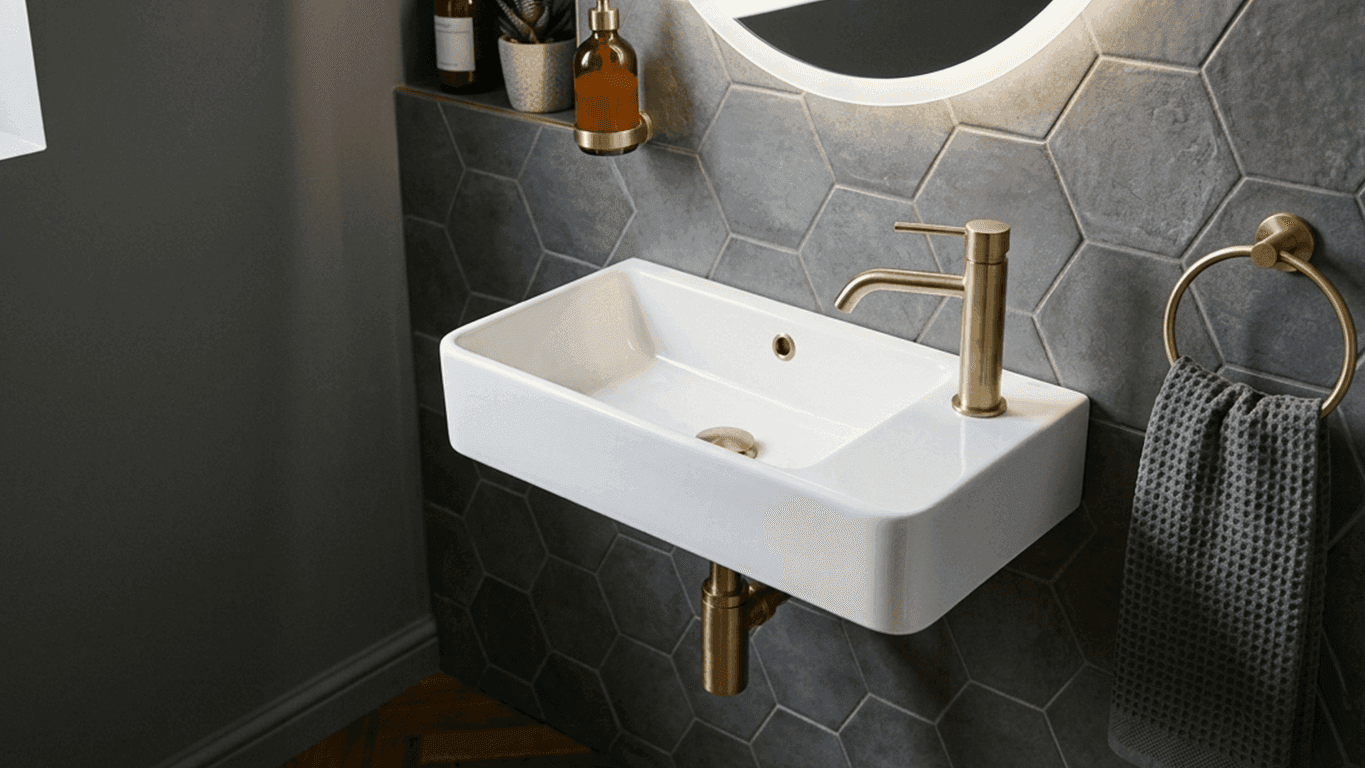
Our guide on taps for a cloakroom or small basin covers this in more detail for tight spaces, where footprint often matters as much as height or reach.
It's also worth checking clearance behind the tap, particularly with a tall spout or a pull-out spray head, since some taps need more depth than expected to swivel or extend fully without catching on a splashback or window sill.
Good to know
Dimensions on a listing are usually the tap's own measurements, not how it will sit relative to your specific sink or basin. Two taps with identical stated spout heights can feel completely different once fitted, if one basin sits noticeably deeper than the other.
Typical dimensions by tap type
As a rough general guide rather than a fixed standard, kitchen taps typically run 180 to 250mm in spout height with a swivel reach of 200 to 250mm.
Basin taps run shorter, 100 to 180mm. That height gap is one of the main reasons a kitchen tap rarely suits a bathroom basin, which our guide on kitchen versus bathroom taps explains.
Bath fillers need a longer reach to clear the bath's rim safely, commonly 150 to 200mm, and our guide on choosing a bath tap covers the rest of what to check.
Shower valves are less about spout dimensions and more about the handset or riser rail height, which our guide on choosing a shower tap covers separately.
How to measure your own space before buying
Measure from the sink or basin bed straight up to where the tap will sit, note the bowl's depth, and measure the distance from the tap hole to the front and back edges of the bowl to work out how much reach you actually have room for.
If you're replacing an existing tap you're happy with, measuring it directly is the simplest reference point, since you already know it fits and works well in daily use.
Mistakes worth avoiding
- Assuming taller is always better. Extra height without matching bowl depth just means more splashing, not more usefulness.
- Ignoring reach on a double bowl sink. A short reach can leave one bowl noticeably awkward to use without a swivel spout to compensate.
- Not checking base footprint on a small sink or basin. A wide tap body can simply not fit the available flat deck space, regardless of how good the spout dimensions look.
- Forgetting clearance behind the tap. A tall spout or pull-out head sometimes needs more depth to move freely than a splashback or window sill allows.
- Comparing listed dimensions without checking your own sink's depth. The same spout height can feel completely different on a deep bowl versus a shallow one.
Once you know the dimensions that suit your space, our guide on choosing a kitchen tap and our top 10 kitchen taps page are worth a look, and our guide on tap connection sizes covers the thread and fitting side once you've settled on the right size.