The Tap Guide

A bath tap gets far less daily use than a kitchen or basin tap, but it has to do one job properly: fill a full bath in a reasonable time, at a temperature you can actually control. Here's what's worth thinking about before you buy one.
Flow rate matters here more than almost any other tap in the house, since it's the one thing that decides whether filling a bath takes five minutes or twenty, and it's easy to overlook when you're choosing mainly on looks.
Bath filler or bath and shower mixer
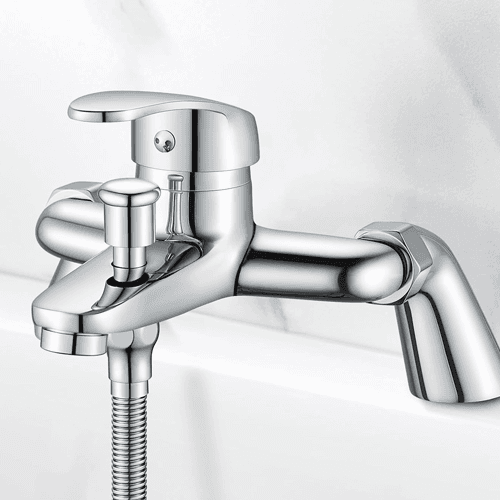
A bath filler is a standalone tap that only fills the bath, usually deck mounted at one end. Bath and shower mixers do the same job but also divert water to a shower head or handset, either built into the tap itself or via a separate riser rail, using a small lever or button on the spout to switch between the two.
If you use a handheld shower over the bath regularly rather than a separate enclosure, the mixer version saves fitting a whole second system. A bathroom that already has a proper shower elsewhere is better served by a simple filler, often the more sensible, cheaper choice.
Our top pick right now
Why flow rate matters more here than anywhere else in the house
Nobody wants to stand around for twenty minutes waiting for a bath to fill, so flow rate is worth checking properly rather than assuming any bath tap will do. Bath fillers are built with a higher flow rate than basin or kitchen taps as standard, but the actual figure still varies a fair amount between models.
Your home's water system affects this as much as the tap itself. On a combi boiler or unvented cylinder, most bath fillers perform close to their stated rate. On a gravity fed system with a loft tank, a weaker hot supply can leave filling noticeably slower than the spec sheet suggests, so it's worth reading our guide on what flow rate you actually need before you buy.
Deck mounted, wall mounted, or freestanding
Deck mounted fillers sit directly on the bath surround and are the simplest to fit, since the pipework stays accessible underneath or behind a bath panel. This is the right choice for the vast majority of bathrooms and refits.
Wall mounted fillers sit above the bath on the wall itself, giving a cleaner look and keeping the bath surround completely clear, but they need pipework routed through the wall at the right height, best planned in at first fix stage. Freestanding fillers, standing on the floor beside a freestanding bath, are a striking look for a statement bathroom but need pipework running up through the floor, which is a bigger job again and usually only sensible during a full renovation.
Waterfall spouts versus standard spouts
A waterfall filler releases water as a wide, flat sheet rather than a single stream, and it's become a popular look for a statement bathroom, particularly paired with a freestanding or wall mounted tap. The trade-off is largely noise, some people love the calming sound, others find it louder than a standard spout, especially at low flow, and a slightly wider footprint at the outlet, so check clearance against your bath's edge before committing to one.
Cleaning is also a bit different. The wide, often square outlet doesn't clog with limescale the way a standard aerator does, but it needs a wipe more regularly to avoid a chalky rim forming along the edge in a hard water area, our limescale guide covers the products worth using.
Flow rate on a decent waterfall filler is usually comparable to a standard spout of similar quality, so don't assume the dramatic look comes at the cost of fill time, though it's still worth checking a specific model's stated rate rather than assuming from the look alone.
Waste, overflow, and click-clack plugs
A bath tap purchase often comes with a decision about the waste and overflow too, since many are sold as matching sets. Click-clack plugs, operated by pressing down on the plug itself rather than pulling a lever, are the simplest and most reliable option for most baths, with fewer moving parts to eventually wear out than a lever-operated waste.
Matching the tap to your bath material
Steel and acrylic baths are the most common in the UK and cope fine with any standard bath tap, provided the fixing nut underneath isn't overtightened during fitting. Cast iron and stone resin baths are heavier and more rigid, which actually makes fitting slightly easier since there's less flex in the surface to worry about.
Whatever the material, avoid using excessive force on the fixing nut. It's one of the most common causes of a cracked bath surround, and firm and snug by hand is all it needs.
Thermostatic bath fillers and safety
A thermostatic valve holds your chosen temperature steady even if pressure changes elsewhere in the house, which matters more for a bath than you'd think, since a young child or elderly relative getting into water that's suddenly turned much hotter than expected is a genuine scald risk. If the bath is used regularly by children or anyone with reduced mobility, a thermostatic filler is worth the extra cost. RoSPA's guidance on preventing bath scalds is worth a read if safety is a particular concern in your household.
Finish and how it holds up
Chrome remains the easiest bath tap finish to keep looking sharp, covered in our limescale guide, and it copes well with the splashing a bath filler inevitably produces. Brushed and matt finishes look striking but show water spots more visibly around a bath, where splashing is heavier and more frequent than at a basin.
Handset attachments and cleaning the bath
Some bath and shower mixers include a small pull-out handset on a short hose purely for rinsing the bath itself, separate from the main shower diverter function. It's a handy feature for cleaning around the edges of the bath or rinsing shampoo out of hair without needing the full overhead shower running.
If your bath doesn't have this and you find yourself using a jug to rinse it, it's worth checking for this feature specifically when comparing bath and shower mixers, since not every model includes it even within the same price bracket.
Getting the tap height right
Bath filler spouts sit higher above the water line than a basin tap would, partly to give clearance as the bath fills and partly so the flow doesn't simply trickle down the side. Too low and you'll get splashing as the water level rises; too high and filling feels slower than it should because the water has further to fall and aerates more on the way down.
Most standard bath fillers get this balance right out of the box, but it's worth checking a specific tap's spout height against your bath's depth if you're choosing a wall mounted or freestanding model, since these sit at a fixed height determined by the pipework rather than adjusting to the bath itself.
What you'll pay at each price point
Budget bath fillers start from around £50 to £90 and do the basic job reliably (prices as of our last check), provided they carry WRAS approval. Mid-range fillers from £100 to £250 typically bring a noticeably higher flow rate and a smoother ceramic disc cartridge. Premium wall mounted or freestanding fillers, particularly thermostatic ones, easily run past £400, with much of that cost going into the higher flow mechanism and finish durability rather than just the badge.
Cost tip
A bath and shower mixer with a diverter is almost always cheaper than fitting a separate filler and a separate shower system, so price both routes before deciding, particularly in a smaller bathroom with no room for a second system.
Mistakes worth avoiding when choosing one
- Choosing a bath filler on looks alone without checking flow rate. A striking tap that takes twenty minutes to fill the bath gets old fast.
- Overtightening the fixing nut during installation. Firm and snug is enough; cracked bath surrounds are one of the most common and avoidable installation mistakes.
- Fitting a wall mounted filler without planning the pipe run first. This needs to be sorted at first fix stage, not retrofitted casually into a finished wall.
- Skipping a thermostatic valve for a family bathroom. The extra cost is small next to the genuine scald risk it removes for young children.
- Assuming any bath filler works the same on a gravity fed system. Check the tap's minimum pressure rating if your home has a loft tank rather than a combi or unvented cylinder.
Once you know roughly what you need, our top 10 bath taps page is a good place to compare specific models, and our wider guide on choosing a bathroom tap covers basin taps and shower valves too if you're doing a full refit. If low pressure is a wider issue in your home rather than just this one fixture, our guide on increasing water pressure from a tap covers the likely causes.