The Tap Guide
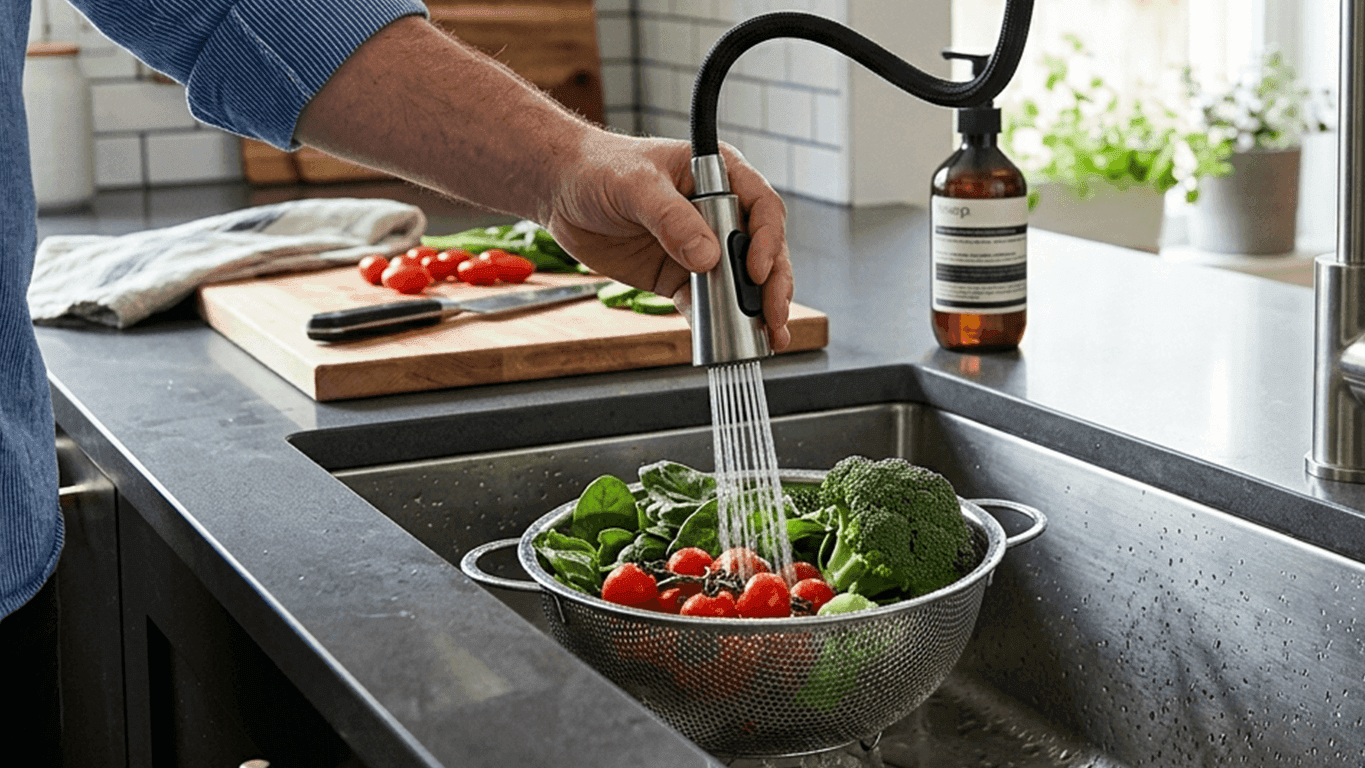
Stand in front of any kitchen tap display and you'll notice two very different shapes on offer: a lower, flatter tap where the spray head pulls straight out towards you, and a tall, arched tap where the head pulls down from above the spout.
Both do the same basic job of getting water beyond the reach of a fixed spout, but they solve that problem in very different ways, and which one suits you depends far more on your sink and cabinets than on which photo looks nicer online.
What's actually different between the two
The names describe exactly what happens when you use them, which helps once you picture it properly. A pull-out tap sits fairly low and flat, similar in profile to a standard mixer, and the spray head detaches by coming straight out of the spout towards you on a hose, then retracts back in roughly the same horizontal line it came from.
Pull-down taps, by contrast, have a tall, gooseneck-style arc that rises well above the sink, and the spray head releases downward, pulling out of the top of the arc and down towards the basin rather than towards you.
That difference in geometry changes how each one feels in daily use. Pull-out taps tend to sit closer to worktop height, so they slide neatly under low wall cabinets or a windowsill positioned just above the sink.
Pull-down taps need real headroom because of that tall arc, but in return they give you a lot more vertical clearance for filling stockpots, tall vases or big mixing bowls without tipping them sideways.
Neither mechanism is better in the abstract. It comes down to what's above your sink and what you're usually filling in it, which is worth thinking through properly before you fall for a design purely because it looks striking in a showroom.
Which suits your kitchen layout
If there's a cabinet, extractor or window sitting directly above your sink with limited clearance, a pull-down tap's tall arc might not fit, or it'll fit so tightly that reaching the spray head release becomes awkward every time you use it.
This is one of the most common measuring mistakes people make when ordering online without checking, so measure the gap between your worktop and whatever sits above it before choosing anything with a high arc.
A low, flat pull-out design avoids that problem entirely and works well in galley kitchens, under-window sink runs, or anywhere ceiling height or a cabinet above is tight. It's also a sensible pick if you've got a single average-depth bowl and don't often need to fill anything unusually tall.
A tall single bowl, particularly one of the deeper Belfast-style or large single-bowl designs that have become popular, is where a pull-down tap really earns its keep. The height means you can get a full stockpot or a tall vase properly under running water without wedging it in at an angle, and the straight-down spray action rinses a large bowl edge to edge more naturally than a tap positioned further back.
Spray head features worth having
Beyond the pull-out or pull-down mechanism itself, the spray head is where the day to day differences really show up. Most decent kitchen taps in this category now offer a toggle between a solid stream, useful for filling a kettle or pan quickly, and a wider spray pattern that's gentler and better for rinsing vegetables or delicate items without splashing everywhere.
Cheaper models sometimes only manage one setting well, with the other feeling weak or overly forceful, so it's worth checking reviews or testing one in a showroom if you can.
A pause button on the spray head, which stops the flow without you needing to reach back to the handle, is a small feature that turns out to matter a lot once you're using it daily, particularly if you're rinsing something in stages or swapping items in the sink.
Weight and tension in the head itself matter too. A head that's too heavy will droop and fight the retraction mechanism, while one that's too light can feel flimsy and cheap in the hand.
Neither extreme is pleasant to live with for years, so if you're buying in person rather than online, actually pick the head up and feel how it sits before deciding.
Hose retraction: the part that actually wears out
This is the bit that separates a tap you'll still be happy with in five years from one that starts annoying you within months, and it's rarely mentioned on the box.
When you pull the spray head out and let go, something needs to draw the hose back into the tap body neatly, and there are three common approaches.
Weighted retraction uses a small weight attached to the hose inside the tap, relying on gravity to pull it back down and in. It's a simple, mechanical solution that's been used for years and works reliably, though it can occasionally leave the hose sitting slightly loose or with a bit of give in the tap body.
Magnetic docking uses a magnet built into the spray head and a matching magnet or metal plate in the housing, so the head clicks firmly into place and sits flush every time. Done well, this feels satisfying to use and stops the head wandering or sitting askew after a few weeks.
The catch is that magnet quality varies enormously between manufacturers, and on cheaper taps the magnets can weaken over a few years of daily use, at which point the head stops docking properly and starts hanging loose or sitting crooked, which is often the first sign a tap needs attention rather than replacing outright.
Spring-loaded or ball-valve systems use tension within the hose assembly itself to pull it back in, and tend to sit somewhere in the middle for cost and reliability, though the springs can lose tension over time in much the same way magnets can weaken.
None of this is visible when you're comparing taps on a website, so it's worth reading specific product reviews rather than trusting the marketing copy, and where possible asking a showroom or a fitter which brands they'd trust for the internals rather than just the finish.
What tends to go wrong over time
Kinking of the internal hose is probably the single biggest cause of a pull-out or pull-down tap losing its smooth action, usually from repeatedly yanking the head out to its full length or twisting it while it's extended. Treat the hose gently and it'll generally outlast the rest of the tap.
Valve wear inside the spray head itself, the part that switches between stream and spray, is the next most common failure point, and it tends to show up as a setting that used to be crisp becoming mushy or unresponsive. On better taps this is a replaceable cartridge; on cheaper ones the whole head sometimes needs swapping entirely.
Docking or retraction weakening, as mentioned above, is the third common issue and is really a question of investing in a brand with a reputation for good internals rather than something you can spot in a shop.
If a low flow rate is behind a tap feeling weak rather than a genuine fault, that's a different problem entirely, and our guide on what flow rate you need covers that separately. And if the whole tap starts dripping rather than the spray head misbehaving, that's almost always a washer or cartridge issue at the base rather than anything to do with the pull-out mechanism, which our guide on fixing a dripping tap walks through.
Budget and cost differences
Pull-out taps tend to sit slightly cheaper than pull-down equivalents at the same quality tier, mainly because the shorter hose run and simpler geometry cost less to engineer. Expect a gap of perhaps £20 to £50 at the budget and mid-range end, based on what we saw at our last check.
That gap narrows or disappears entirely at the premium end, where finish, valve quality and warranty matter more to the price than the mechanism style.
The bigger cost swing is actually within the retraction mechanism itself rather than between pull-out and pull-down. Basic weighted retraction is the cheapest to produce and shows up across budget ranges from around £60 to £120.
Ball-valve and spring-loaded systems generally sit in the £100 to £200 range.
Good magnetic docking, done properly with strong, long-lasting magnets rather than a token weak one, tends to push a tap into premium territory, often £150 and upwards, and this is one area where paying a bit more buys real durability rather than just a nicer badge.
If you're comparing manufacturers at this point, our rundown of the best tap brands in the UK is a sensible next stop before you commit.
It's also worth checking that anything you buy meets UK water regulations, particularly if you're fitting it yourself.
A WRAS approval mark on a product is a reliable shorthand for this, and if you're at all unsure about the installation itself, a search through WaterSafe will find you an approved local plumber rather than leaving it to guesswork.
Quick tip
Measure the tap hole diameter and worktop thickness before you buy, since pull-down taps in particular can have a wider base and taller stem that need more clearance than the tap you're replacing.
Where people go wrong choosing between them
- Not checking cabinet or wall clearance. A pull-down tap's tall arc needs genuine headroom, so measure the gap above your sink before ordering rather than assuming it'll fit because the last one did.
- Choosing pull-out purely on looks without checking the retraction mechanism. A flat, understated tap can still hide a weak weighted system or cheap magnets, so look past the finish and check what's actually inside before you buy.
- Ignoring the weight and tension of the spray head handle. A head that feels too heavy or too light in a showroom will feel the same way at home every single day, so pick it up and test it rather than judging from a photo.
- Not checking spout height against tall pans or a deep sink. If you regularly fill stockpots or watering cans, a low pull-out spout can leave you tilting things awkwardly under the flow.
- Assuming all magnetic docking is equally good. Cheap magnets weaken within a few years and stop holding the head in place properly, while good ones keep clicking firmly for a decade or more.
- Forgetting to check tap hole size and worktop thickness. Pull-down taps in particular sometimes need a wider hole or a thinner worktop than a standard mixer, which catches out a lot of people replacing like for like.
Once you've worked out whether your kitchen favours a pull-out or a pull-down, and roughly what you want to spend, the practical decision becomes much easier.
If you're still narrowing down the wider choice of finish, spout height and flow rate before you get this far, our guide on how to choose a kitchen tap covers the fundamentals, and if you're planning to fit it yourself, our step-by-step guide on how to install a tap is a good place to check what's involved. When you're ready to compare specific models, take a look at our top kitchen tap picks across different budgets.