The Tap Guide

Screw-on tap attachments that switch between a full stream and a spray have been around for years, sold cheaply online and in hardware shops as a way to add a spray function to a tap that doesn't already have one.
Here's what they actually do, how well they work, and when a built-in spray function is the better route instead. We'll cover how the switch mechanism works, thread sizes and fitting, and what effect, if any, an attachment has on your water pressure.
What these attachments actually are
A spray diverter attachment screws onto the end of your spout in place of the standard aerator, adding a small lever or twist mechanism that switches the water between a solid stream and a wider, softer spray pattern. Some versions also add a pause function, stopping the flow entirely without touching the tap handle, useful for rinsing something in stages.
They're entirely mechanical, no batteries or wiring involved, and they work by redirecting water through different internal channels depending on the position you set, similar in principle to the spray head on a pull-out kitchen tap but built into a much smaller, fixed attachment.
How the spray and full-flow switch works
Inside the housing, a small rotating disc or lever opens and closes different sets of holes. The stream setting sends water through fewer, larger openings for a solid flow good for filling a glass or pan quickly. Spray setting forces it through many smaller holes instead, breaking the flow into a wider, gentler pattern better suited to rinsing vegetables or washing hands without splashing everywhere.
Fitting one: thread sizes and adapters
Most attachments are designed to fit the common UK aerator thread sizes, typically 22mm male or 24mm female, and better quality kits include a couple of adapter rings to cover both. Our guide on tap connection sizes explained covers these standard sizes in more detail if you want to check compatibility before buying.
Fitting one is usually a five minute job: unscrew the existing aerator, fit any adapter needed, then screw the new attachment on by hand until snug.
Common cause
A cheap attachment that doesn't seat properly against the spout thread is a common source of a new, small drip right at the spout tip. If yours weeps after fitting, check the seal washer is present and correctly seated before assuming the attachment itself is faulty.
A spray attachment worth a look
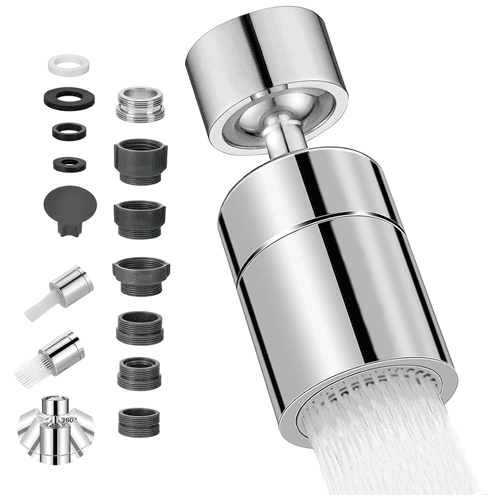
Lubekas Kitchen Tap Spray Head
£13.99 (correct as of October 2026)
A screw-on spray diverter with two flow settings, a soft foaming spray and a stronger jet, built around a solid brass swivel head that turns a full 360° to reach across a wider sink. It also comes with a four-layer internal filter to catch sediment before it reaches the nozzle, plus six adapters covering 20mm, 22mm and 24mm threads, so it's a genuine drop-in fit for most standard UK kitchen taps.
We like
- Six included adapters cover 20mm, 22mm and 24mm threads, so it fits most UK kitchen taps without buying parts separately
- Four-layer internal filter helps catch sediment and reduces the chance of the nozzle clogging over time
- Solid brass swivel head rotates a full 360°, useful for reaching across a wider sink or double bowl
Worth checking
- Only two flow settings, foaming spray and a stronger jet, with no separate pause function, despite sitting at the price point where our guide notes a pause function usually starts appearing
- Thread size
- 20mm, 22mm and 24mm (adapters included)
- Materials
- ABS housing, brass swivel head
- Finish
- Chrome
- Flow modes
- 2: foaming spray and powerful jet spray
- Filter
- 4-layer internal filter
- Weight
- 70g
Specifications above listed by Amazon and may change. Check the current listing before buying. If we've got something wrong, let us know and we'll fix it.
Where they actually help
For a tap that only has a single fixed stream and no spray function at all, a diverter attachment is a cheap, quick way to add real everyday usefulness, particularly for rinsing vegetables, washing up, or filling a watering can without splashing. It's a sensible option for a rental property where replacing the whole tap isn't practical, or simply as a low cost trial before committing to a full tap replacement.
Where they fall short compared to a built-in spray function
A built-in pull-out or pull-down spray head, covered in our guide on pull-out versus pull-down taps, gives you reach as well as spray pattern, letting you direct water anywhere around the sink rather than just changing the pattern at a fixed point. Fixed attachments can't move, so they don't help with reaching into a tall pan or a double bowl sink the way a hose-based spray head does.
Build quality also varies a lot more at this end of the market. Cheap attachments can feel plasticky, and the internal mechanism sometimes wears or clogs with limescale faster than the equivalent mechanism in a proper tap.
Effect on water pressure and flow
Adding any attachment introduces a bit more resistance than a standard aerator, so a very slight drop in flow is normal and expected, similar to how a standard aerator behaves compared to a bare spout. This is rarely noticeable on a strong mains or combi boiler supply. On an already weak gravity fed system, it's worth checking reviews for a specific product's flow rate before buying, since a poorly designed attachment can make a marginal pressure situation feel worse.
Choosing between an attachment and a new tap
If your tap is otherwise in good condition and you just want the spray function occasionally, an attachment is the sensible, low cost choice. An old or worn tap, or one you're already considering replacing for other reasons, is a different case. It's often better value to put that money toward a tap with a proper built-in pull-out spray rather than layering an attachment onto a tap you'll likely replace before long anyway.
What these attachments cost
Basic spray diverter attachments start from around £5 to £12, generally plastic bodied with a simple two-setting switch (prices as of our last check). Mid-range metal-bodied versions with a pause function and multiple adapter rings typically run £12 to £25. Above that, you're better off pricing a tap with a genuine built-in pull-out spray, covered in our guide on choosing a kitchen tap, since the cost gap narrows quickly and a proper spray head performs noticeably better.
Mistakes worth avoiding
- Buying without checking your spout's thread size first. Most kits include adapters, but it's still worth checking rather than assuming a universal fit.
- Overtightening the attachment onto the spout thread. Hand tight is enough; overtightening can crack the housing or damage the spout thread itself.
- Expecting reach as well as spray pattern. A fixed attachment only changes the water pattern, it doesn't move like a hose-based spray head does.
- Ignoring a new drip at the spout after fitting. This is almost always a missing or misaligned seal washer, an easy fix rather than a faulty product.
- Buying the cheapest option for a tap you use constantly. A flimsy mechanism on a heavily used kitchen tap wears out fast; it's worth spending a little more for a metal-bodied version if it'll see daily use.
If you decide a proper built-in spray function makes more sense, our guide on choosing a kitchen tap and our top kitchen tap picks are both worth a look before you buy.