The Tap Guide
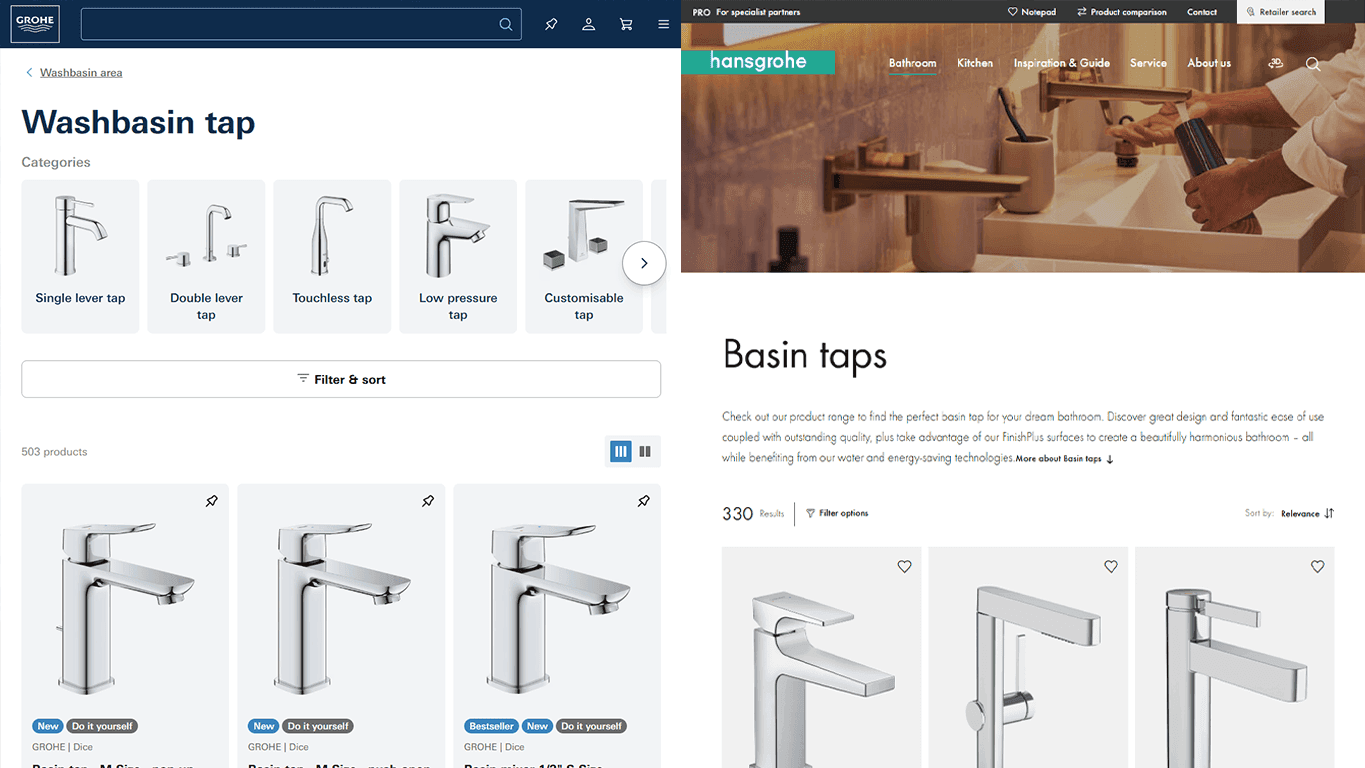
Grohe and Hansgrohe come up together constantly when people research premium taps, and honestly, that pairing is mostly a marketing convenience rather than a real rivalry. Both are German, both are old enough to have grandchildren working there, and both charge about the same for a decent thermostatic valve.
The interesting question isn't which one is "better", it's which one is better for the specific job you're actually doing. Both brands trace back over a century, and both still engineer largely in Germany despite Grohe now sitting under Japan's LIXIL and Hansgrohe under the US group Masco, so we'll skip the potted biography and get straight to what actually differs.
Cartridge and mechanism technology
Grohe calls its cartridge system SilkMove and has backed most ranges with a guarantee running two to five years, stretching to ten years on selected products, though it's worth checking the current terms on the specific model rather than assuming. Hansgrohe's equivalent leans harder on long term consistency claims than a snappy brand name.
Strip away the marketing and both feel smooth and precise brand new, which tells you almost nothing, since every tap feels good in a showroom. The real test is what the cartridge feels like in year eight, and that's not something either brand's own literature is going to tell you honestly.
The anti-limescale coatings, SpeedClean from Grohe and QuickClean from Hansgrohe, work on the same principle: a smoother nozzle surface that mineral deposits struggle to grip.
Worth knowing before you pay extra for either: no coating stops limescale forming in a properly hard water area, it just makes the eventual wipe-down easier. If limescale is your main worry, our guide on cleaning limescale from taps will do more for you than either brand's proprietary coating.
Kitchen taps
Grohe simply has more kitchen taps. The range runs from mixers that aren't much pricier than a mid-tier own-brand right up to Grohe Blue and Red boiling water systems, so if you want one brand to cover the whole kitchen, Grohe gives you more to actually choose from.
Hansgrohe plays a narrower game here, concentrating on higher end pull-down designs with AirPower aeration mixing air into the stream. It's a noticeably nice feeling flow. Whether it's worth paying a premium for over a well specified Grohe pull-down is a matter of taste rather than a clear technical win either way.
Showers: where Hansgrohe pulls ahead
This is the one section where we'd give a straight answer without much hedging. Hansgrohe's shower systems, valves and heads are consistently the stronger reputation of the two, and it's the more common first pick for a premium bathroom refit built around the shower.
Grohe's shower valves are perfectly reliable, but if the shower is the fixture you actually care about, weight this section more heavily than anything else on the page.
Finish durability and warranty
Chrome, brushed nickel, and the usual spread of matt and coloured premium finishes, both brands offer a near-identical line-up, and both hold up about as well as each other with proper care; our guide on cleaning limescale from taps applies equally to either.
Warranty terms both typically run to five years on the standard product, sometimes longer on the cartridge specifically, but read the actual terms on the model you're considering rather than assuming the brand name guarantees consistency across the whole range.
Before you buy
Both brands' full ranges are checkable against the WRAS approved fittings directory. See our guide on what WRAS approval actually means if you're not sure what to look for, and confirm the specific model you're buying is listed, particularly if buying through a third party seller rather than an authorised retailer.
Price and where the money goes
Grohe dips a little lower at the entry level, Hansgrohe generally starts a notch higher across the board, but at the premium end the two land close enough together that price rarely settles the decision on its own.
Spare parts and long term support
Ten years from now, when a cartridge finally gives up, both brands will still have genuine replacement parts available directly or through an approved stockist rather than leaving you hunting for a universal substitute.
That's the real payoff of buying an established name over something unbranded and cheaper: not the badge, but the certainty that a worn part has somewhere to go.
Which one should you actually pick
Doing a full kitchen and bathroom refit and want one brand to cover it all? Grohe's wider catalogue makes that easier, especially if a boiling water tap is anywhere on the list.
Is the shower the fixture you actually care about? Go and read the Hansgrohe section again, because that's the one place this comparison isn't really close.
For everything else, a basin tap, a straightforward kitchen mixer, a standard thermostatic valve, both perform reliably enough that you're really choosing a finish and a look you won't tire of, not a mechanism.
What each brand actually costs
Grohe kitchen mixers typically start from around £80 to £120 at the accessible end of the range (figures from our last check), with mid-range models £150 to £300, and premium or boiling water systems £400 upward.
Hansgrohe kitchen taps typically start a little higher, from around £120 to £180, with premium pull-down designs commonly running £300 to £600.
Shower valves from either brand generally sit in the £150 to £400 range for a good thermostatic option, with Hansgrohe's premium shower systems able to run considerably higher for a full multi-outlet setup.
Where people choose the wrong one
- Choosing based on brand alone rather than the specific model's cartridge warranty. Terms vary by range within each brand, so check the specific product rather than assuming brand-wide consistency.
- Assuming Hansgrohe is always the better choice for a shower. Its reputation is strongest at the premium end; for a straightforward, reliable shower valve, Grohe performs perfectly well too.
- Overlooking Grohe's boiling water and filtered tap range if that's what you actually want. Hansgrohe's range doesn't cover this category in the same way.
- Assuming both brands' anti-limescale coatings perform identically. SpeedClean and QuickClean are broadly similar in principle but worth checking independent reviews for a specific model's real-world performance in your water hardness area.
- Buying from an unauthorised seller without checking WRAS approval. Grey market stock can sometimes lack the correct UK approval or warranty support, so buy through an authorised retailer where possible.
For a wider look at other manufacturers worth knowing, our guide on the best tap brands in the UK covers the full field, and our top 10 kitchen taps and top 10 shower taps pages are a good place to compare specific models across brands.